Summer 2019 | Downtown Magazine | By Deborah L. Martin
A WISE PERSON ONCE SAID, “Charity begins at home,” and we agree. The problems of the world often seem insurmountable, but there are organizations that are doing life-changing work right here in New York City—helping one person, one child, one human being at a time. For this special feature, we focused on just six out of the countless worthy organizations working to better this city, and as a result, the world. The Museum of Jewish Heritage, Henry Street Settlement, Girl Be Heard, National Dance Institute, Oliver Scholars, and Project Renewal all focus on different issues affecting our New York communities. With the help of dedicated staff and volunteers, they use their creative energy to reach our most at-risk, vulnerable residents, and to help them achieve their fullest potential. They teach lessons in acceptance and tolerance, appreciation for the arts, and cooperation, and they fight to make sure every voice is heard. In doing so, they empower our neighbors to take control of their lives and to gain confidence and valuable skills. These are our givers…
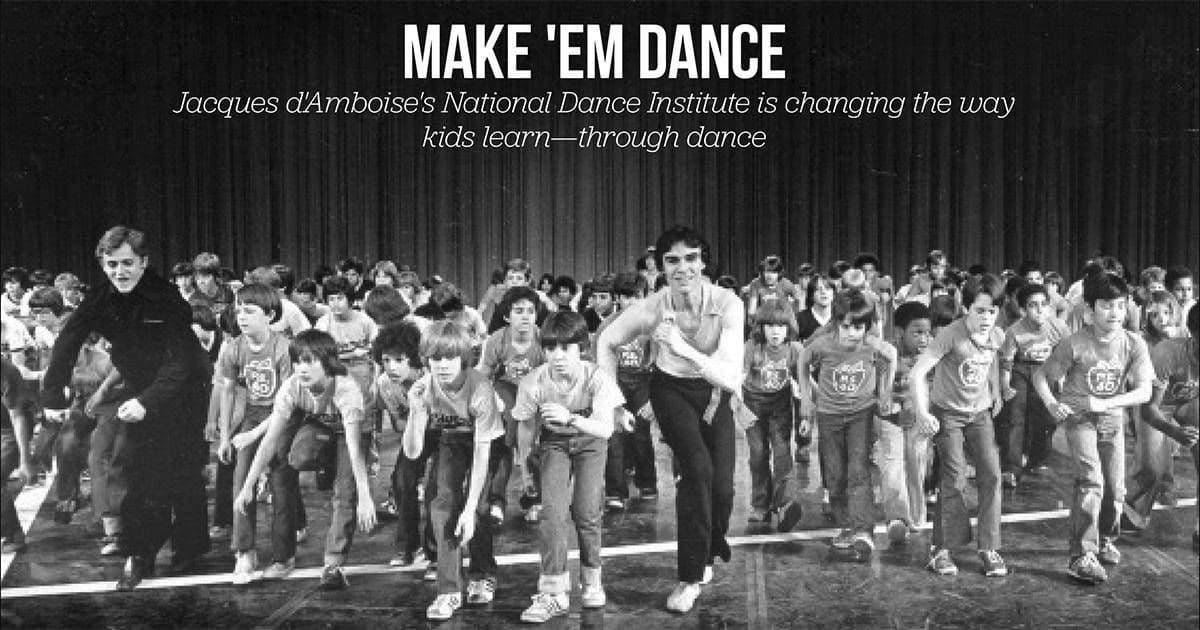
JACQUES D’AMBOISE RECALLS the time he was on the subway and sitting across from him was a gentleman who stared at him with a very somber look. “There was a lot of space around him, and suddenly there was a lot of space around me—people were backing away. Then I hear him say, ‘I was a tomato.’” d’Amboise laughs. “He was one of our students and he was in a show that we did called Best Friends, in which we told the story of the Marquise de Lafayette, who became friends with George Washington and took him to dine in Paris. They had frog’s legs, pommes frites, green lettuce, gateux, and tomate à la provençale. He was a tomato.”
A principle danseur with New York City Ballet under George Balanchine, d’Amboise joined the company when he was 15 years old and became one of the United States’ most famous dancers. But his earliest memories are of his French-Canadian mother finding ways to make sure that he and his siblings had lessons in music and dance. He never forgot what the classical arts did for him.
In 1975, he approached Balanchine about holding dance lessons for children in the basement of City Center before the company arrived, and Balanchine agreed. “I went to Collegiate where my sons were enrolled, and I asked if anyone was interested in having an exercise class based on ballet. It was really just a way to get my sons interested in dance. I got five or six children in that first class.” Balanchine was choreographing Don Quixote and he needed mini-knights for a dream sequence in the ballet, so he drafted all of the members of d’Amboise’s first class. The following year, d’Amboise receieved a $75,000 grant from the Ford Foundation to create National Dance Institute (NDI).
The organization operated out of offices in SoHo for many years, and had to arrange for donated performance and rehearsal space. Ellen Weinstein, NDI’s artistic director says, “We were nomadic, and we had to beg for space. It was difficult to plan because we never knew where we would be next.” But seven years ago, with seed money from George Soros, they were able raise enough to purchase their headquarters in Harlem, which includes offices, rehearsal space, and a small performance space.
NDI currently runs after-school programs that impact over 6,500 elementary school students per year. They estimate that since their inception they have educated over 2 million students, and there are currently 13 NDI-affiliated schools in the United States. Internationally, there are affiliated programs in Shanghai, Mexico, Russia, Bali, and Lebanon, among others.
The program culminates in the Event of the Year, where students who show a passion for dance participate in a final performance. Weinstein says, “Every class chooses a theme and we have a curriculum. They design the costumes, the tee shirts, the backdrops. This year our theme was Voices of Change, telling the stories of people who have used their voice to affect change, like Malala. Even the most disinterested students get excited about learning. They unite around a shared goal, to create a finished product, and in the process they learn how to care for each other.
“On the days that NDI is in the schools, they have 100% attendance,” says d’Amboise. “No drop outs.” For more information, visit nationaldance.org
Download the full article here.